

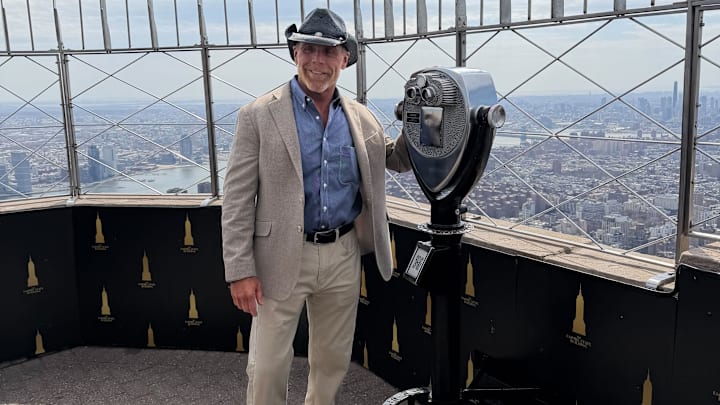
The wind hits a little harder than expected at the top of the Empire State Building.
Some might say it’s the kind of breeze that makes you tug at your clothes, and, in Shawn Michaels’ case, test the security of the lionized brown cowboy hat perched on his head. He laughs it off, brushing away a question about whether it’s glued on, and casually admits it’s his first time up here.
It’s mine too.
The setting almost feels too perfect. Midtown Manhattan stretches endlessly in every direction, a living, breathing machine of movement and ambition. From this height, everything feels organized and purposeful. Like every piece has somewhere it’s supposed to be.
Michaels leans against the railing, looking out over it all, not so much as a tourist, but more as someone who understands how systems function. For the last several years, he’s been at the center of one of the most important ones in professional wrestling, both overseeing it and transforming it.
Because down below, far from the skyline and far removed from this quiet vantage point, another kind of city is constantly under construction.
One built on potential. On projection. On the idea that the next generation isn’t just coming, but that it’s already here, learning in real time.
Michaels doesn’t need the view to see that. He’s been watching it take shape every single day for the last four-and-a-half years.

That system has a name. Three letters: N-X-T.
For more than a decade, WWE’s developmental brand has served as the proving ground for the company’s next generation, a place where raw athletes, independent standouts, and everything in between are molded into complete performers. What began as a competition-based reality show in the early 2010s has evolved into something far more expansive. It’s become a fully realized ecosystem designed to produce stars at a relentless pace.
This week, that system traveled to New York City for a rare Northeast stop, returning to Madison Square Garden as part of WrestleMania season. With Stand & Deliver — NXT’s annual showcase, its version of WrestleMania — looming, the brand’s top names, along with Michaels, made the rounds to promote what has quietly become one of the most important pipelines in professional wrestling.
And that word — pipeline — isn’t an exaggeration.
“[NXT is] the future of WWE,” Michaels says simply. “We build bonafide WWE superstars, and we do it on a regular basis.”
The proof isn’t too hard to find. Over the last year or two alone, names like Oba Femi, Trick Williams, and Tiffany Stratton have moved from prospects to fixtures on the industry’s biggest stage. Others are already on that same path, developing in real time under the same system that produced them.
The future isn’t something you wait for in NXT. It’s something you watch happen in real time.
And if NXT is the future, it’s because of the system behind it. From the outside, it can feel like a constant stream of new faces, new characters, and new stars cycling in and out at a pace that’s at times difficult to track. But inside the Performance Center, and across the brand as a whole, that movement is anything but random. It’s deliberate and structured. It’s built on a foundation that blends coaching, creativity, and repetition.
Relatively recent NXT arrival Ricky Saints has seen enough of the wrestling world to recognize the difference.
Saints, who joined WWE from AEW a little over a year ago and has since added both an NXT Championship and an NXT North American Championship to his resume, speaks about the brand less like a newcomer and more like someone studying a system in real time. There’s an appreciation both for what NXT produces and how it gets there.
“For NXT, there is a level of this unbridled energy that everyone shares,” he says. “You have some very raw talent there that is still trying to be molded and figured out, and you have people who have been doing it for a while that can help mold those talents.”
That balance is the engine that drives it.
At the center of it is a coaching staff that reads like a blueprint for wrestling excellence — Michaels, Matt Bloom, Fit Finlay, Terry Taylor — veterans who have seen every version of the industry and now spend their time teaching the next generation. Around them is a roster built from dramatically different paths, ranging from lifelong wrestlers to former collegiate athletes to international prospects to independent standouts.
Put them in the same space, and something unique starts to happen.
“There’s always this curiosity to it,” Saints says. “This is a first-time matchup. These two styles are completely different. Let’s see how this works.”
That curiosity isn’t accidental. It’s cultivated by the NXT machine.
It shows up in the way talent are encouraged to experiment, to fail, to figure things out in real time. It shows up in the speed of development, in how quickly someone can go from unsure to undeniable. And it shows up in the energy Saints describes — as something that turns a collection of individuals into something closer to a living, evolving ecosystem.
Because for all of its structure, NXT doesn’t exactly operate like a factory. It’s more of a laboratory. And like any experiment, the results depend entirely on what — and who — you put into it.
And increasingly, what NXT is putting into that system isn’t necessarily wrestlers. It’s athletes.
Over the last several years, WWE has doubled down on that approach through initiatives like its NIL program and WWE ID, recruiting high-level competitors from across the sports world and teaching them how to become performers. Not all of them figure it out. But the ones who do, they often redefine the concept of what a modern wrestler truly looks like.
That shift in recruiting philosophy is visible the moment you step inside the room. Tony D’Angelo has lived through it.
A former collegiate wrestler at the University at Buffalo who has spent the better part of five years in NXT, D’Angelo has seen the brand evolve from the black-and-gold era to NXT 2.0 to what it is today. In many ways, he sits right at the intersection of it all as an athlete by background, a performer by trade, and now a veteran voice in a constantly rotating locker room.
And from his perspective, the influx of athletes is both noticeable and necessary.
There’s a difference, he explains, in how they approach the process. Athletes arrive without the habits that can sometimes come with years on the independent circuit. They’re coachable. Open. Willing to be molded.
And when that mindset clicks with the structure around it, the results are like nothing we’ve seen before. D’Angelo has seen it firsthand in names like Oba Femi, who took his collegiate track and field background and translated it into a larger-than-life presence inside and outside the ring, or Trick Williams, who evolved from a supporting role alongside Carmelo Hayes into one of the most charismatic stars in wrestling.
It’s a formula that has already worked at the highest level, too. Bianca Belair, once a track and field standout with no prior wrestling experience, is now a WrestleMania main eventer and one of WWE’s most recognizable stars. She’s a product of that same pipeline, just a few years ahead of the current wave.
This type of growth is only possible because of what comes next — because of what happens when those athletes are asked to become something more than what they’ve always been.
When they’re asked to become performers.
That transformation isn’t automatic, though. It has to be learned. For Sol Ruca, it started with a question she had never really been asked before.
A former gymnast at the University of Oregon with a background in acrobatics and tumbling, Ruca arrived in WWE in 2022 with no prior wrestling experience. What she did have was one-of-a-kind athleticism, the kind that quickly translated inside the ring, helping her develop a gravity-defying style and a viral finishing move, a springboard front-flip cutter known as the Sol Snatcher.
That move may have been her initial calling card, but showcasing her remarkable athleticism was never the hardest part of the transition. Instead, it was the required mindset shift.
“In athletics, you’re kind of put in a box,” Ruca says. “This is your routine, this is what you do. I got here, and they were like, ‘What do you want to do? Figure it out.’ No one’s ever asked me that before.”
For someone raised in structured competition, where success is defined by precision and repetition, that kind of creative freedom can feel unfamiliar or even uncomfortable.
There is no routine in wrestling. No single correct answer. The performance lives in the space between the moves — in the expressions, the timing, the connection with a crowd that expects more than execution.
That was the part Ruca had to learn.
“Being able to be a character and to show emotion and facial expressions, that was really strange to me,” she says. “But once I got the hang of it, it’s a lot more fun than trying to be serious all the time.”
It’s a different kind of discipline. Wrestling doesn’t suppress emotion like other athletic fields emphasize — it demands it.
Ruca describes it as a process of discovery, of constantly putting herself in uncomfortable situations and trusting that something will come from it. Naturally introverted, she found herself in an environment that required the opposite, one where confidence isn’t optional, and where personality is just as important as performance.
Over time, that discomfort started to transform into confidence.
“I always feel so much better about myself afterwards,” she says. “It helps me every single time to be more confident in the ring and in these situations with media.”
What emerges from this transformation isn’t just a better and more defined wrestler. It’s a more complete version of the person.
That’s partially why Ruca’s rise feels so special. The flashes are already there — the viral moments, the growing connection with crowds, even brief appearances on WWE’s main roster that hint at what’s coming next. It’s easy to see where this is going.
But the most important part is happening underneath all of that. It’s the figuring it out.
“That’s honestly my favorite part about wrestling,” she says. “It’s like a puzzle, trying to put the pieces together.”
That puzzle is never fully solved down in NXT. It’s something you build, piece by piece, in real time — in front of coaches and teammates, sure, but also in front of an audience watching you become a more complete version of yourself.
And in Ruca’s case, that transformation is already well underway.

Of course, that transformation of figuring out who you are is only part of the equation. Understanding how to use it is something else entirely.
Joe Hendry approaches wrestling differently than most.
A veteran of multiple promotions around the world before ever arriving in NXT, Hendry doesn’t just talk about the business — he dissects it in a way few are able to. Every answer feels intentional, as if he’s spent years not only performing, but studying what actually makes it work. And that’s probably because he has.
Even his own success wasn’t accidental.
“My overnight success,” Hendry says, “was entirely planned. Me and my brother sat down and we put a plan in place… and it happened exactly as we planned it, times 10.”
That’s a statement that sounds almost too deliberate until you realize that’s exactly his point. Belief isn’t blind confidence for Hendry. It’s the very core of who he is.
That idea has followed him throughout his career, eventually becoming part of his identity — a phrase, a mantra, something audiences now echo back to him in sold-out arenas: “I believe in Joe Hendry.”
But behind that connection is something more grounded in reality. It’s an understanding of what actually creates it.
“The common thread in talents that become huge superstars is that they’re authentically themselves,” he says. “They find a way to turn the volume up.”
It sounds simple. It isn’t, though.
Because doing that requires something most performers spend years trying to figure out — knowing who you are, and being willing to show it. Being willing to show it consistently, in front of an audience that gravitates toward authenticity.
“That requires you to be vulnerable in front of the world,” Hendry says. “But that’s often the key to the castle.”
You see, that’s the kind of perspective that only comes from experience, from years of trial and error, from learning what works and what doesn’t. And inside a place like NXT — where so many are still in the early stages of that process — it becomes even more noticeable.
That’s because figuring out who you are is one thing. Proving it is another.
RELATED: WWE captured the art of uniqueness with its Stranger Things-themed Raw
And in NXT, there’s no shortage of people trying to prove themselves, especially in a women’s division that might be the most competitive in all of wrestling.
Few understand that better than Jacy Jayne.
A product of the NXT 2.0 era, Jayne was once viewed as the third piece of Toxic Attraction, one of the brand’s defining factions at the time. A few years later, that perception has changed dramatically.
Now the leader of her own faction, Fatal Influence, Jayne has redefined her place in the division. She’s a multi-time champion and the current NXT Women’s Champion, not just a featured name, but arguably the face of the entire brand.
That distinction feels even more relevant in a division as deep as this one. That’s because for all the talk of development and growth, there’s another reality that defines NXT just as much.
Competition.
“There’s so many girls that are so hungry right now,” Jayne says. “Everybody wants to be in that top spot. Everybody wants to run this place.”
It’s not a hypothetical. It’s the reality of the NXT landscape.
Every day at the Performance Center, every match on television, every opportunity is earned in a room filled with people trying to take your place. There are no guarantees. There is no long-term security. Just constant pressure to get better and to prove that you belong at the top of the division.
Jayne embraces that pressure.
“We’re basically just smoking each other every week,” Jayne says with a laugh. “But that’s what makes it better.”
That’s the standard she has helped set. Not just to be good, but to survive in an environment where everyone else is improving at the same time. Where being comfortable is the quickest way to fall behind. Where the difference between standing out and blending in can come down to a single moment.
Jayne has lived that climb. She’s felt what it’s like to be overlooked, to be part of something without being the center of it. And now, she sits at the top of it, and it’s not by happenstance or serendipitous timing. It’s because she’s adapted to exactly what NXT demands.
Ultimately, in a system built on growth, the ones who last aren’t always the most talented — although talent certainly helps. They’re the ones who can keep up with the standard.
Back at the top of the Empire State Building, the wind still hasn’t let up.
It cuts through the conversations, through the laughter, through the steady rhythm of people moving in and out of the space. Below, the city keeps going, unaware of the smaller conversations happening above it — the ones about what comes next.
I ask Michaels what it’s like to watch it all unfold. Not just the finished product or the end result, but the early stages. The stage of uncertainty and growth.
It’s the process, he tells me. Watching them figure it out. Watching them take what they’ve been given and turn it into something that’s theirs.
That’s the part that never gets old. And it’s the part most people don’t notice.
Because ultimately from the outside, what you see are the moments — the debuts, the call-ups, the viral clips, the matches that make someone feel like they’ve arrived overnight. What you don’t see is everything that led up to it.
But it’s all there. It’s all recorded. Every step. Every mistake. Every adjustment along the way.
“You guys get to watch us grow,” Sol Ruca says.
That might be the simplest way to explain it. Nothing is hidden in NXT. Development doesn’t happen behind closed doors, but rather in front of a live audience, in real time, with every success and every setback becoming part of the story.
That’s what makes NXT what it is.
Standing there, looking out over a city built on movement and constant change, it’s hard not to see the parallel. Everything below is in motion. Always building. Always evolving into something new.
NXT works the same way. It doesn’t stop. It doesn’t wait. And it doesn’t need to.
Because this isn’t the future of wrestling. The future is already here.
 Add us as a preferred source on Google